Sandbox CCU Edition #2
Over ten dynamic days (from 25 Aug to 5 Sep 2025), Sandbox CCU Edition #2 brought together undergraduate students across disciplines at Techno India University. Under the co-design and facilitation of the rebalance institute and Elseplay, the experience invited participants to dive deep into real‐world urban challenges, prototype ideas, and refine concepts for a more sustainable, inclusive Kolkata.
Overview
Dates: 25 August 2025 – 5 September 2025
Location: Techno India University, Kolkata
Partners: Elseplay; Techno India University
Focus: A ten-day immersive learning sprint where student teams reimagined Kolkata’s future—centred on sustainability, inclusion, innovation and social impact.
Over ten dynamic days (from 25 Aug to 5 Sep 2025), Sandbox CCU Edition #2 brought together undergraduate students across disciplines at Techno India University. Under the co-design and facilitation of the rebalance institute and Elseplay, the experience invited participants to dive deep into real-world urban challenges, prototype ideas, and refine concepts for a more sustainable, inclusive Kolkata.
The environment was intentionally collaborative and experiential—reflecting the rebalance institute’s approach of “fun + rigor, experiential, dialogic, reflective, modular”. Students engaged in workshops, design sprints, peer reflection sessions, prototyping labs, and a final open-house showcase to present their work.
Our Role & Approach
As the rebalance institute, we served as one of the designer-facilitator of this custom learning experience.
Key aspects include:
Co-creation with partners: working alongside Elseplay and Techno India University to design the curriculum, flow and outcomes.
Integrated themes: thematic anchors included sustainability (environmental + human), social innovation and responsible leadership—aligned with our core pillars.
Learning design: the ten-day sprint was structured modularly, with phases for problem-framing, ideation, prototyping, feedback/iteration and public presentation. The tone was energetic yet reflective, inviting students to think deeply about urban futures while also enabling playful creativity.
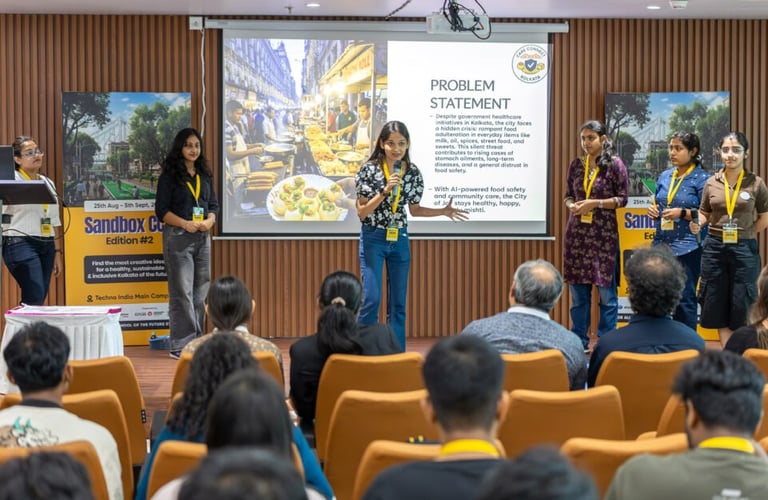
Outcome-oriented: the experience ended with a Final Project Showcase & Open House (5 September) where student teams exhibited their prototypes and received peer, mentor and stakeholder feedback.
Impact & Highlights
Engaged a diverse cohort of students (from multiple disciplines) in a cross-cutting challenge to imagine better urban systems.
Generated a range of prototype solutions addressing themes such as public-space design, inclusive mobility, community-health frameworks and technology-enabled citizen participation.
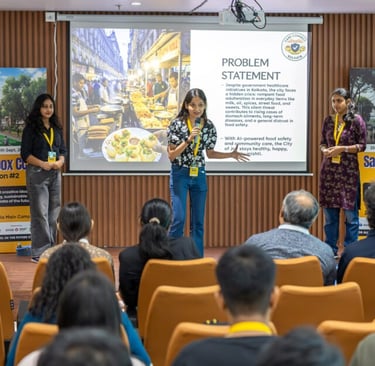
The final day’s public open-house enabled students to present to peers, faculty and broader stakeholders, thereby amplifying reach and visibility.
The immersive nature of the programme, combined with real-world challenge-framing, reflected our belief that learning is most meaningful when it connects to lived systems and invites reflection and action.
Why This Programme Matters
It aligns with the rebalance institute’s north-star question of “How might learners engage to shape sustainable, inclusive futures?”
It illustrates our commitment to hands-on workshops, content curation and training (in this case, via a workshop-intensive sprint) in a modular and dialogic format.
It shows effective partnership (university + creative organisation + our institute), which we advocate as best-practice.
It offers measurable outcomes (student engagement, prototype development, stakeholder showcase) which feed into our success-metrics framework (participation, engagement, learning outcomes).
GET IN TOUCH
© 2025. All rights reserved.
learning experiences you’ll remember for decades
explore
work with us